
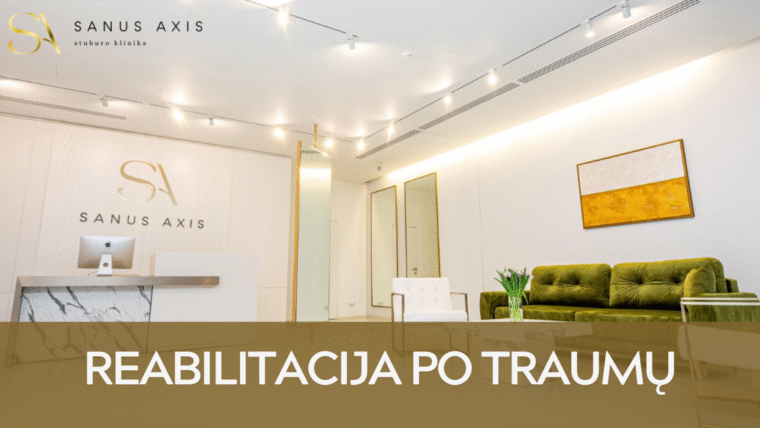
Rehabilitation after surgery, injuries, and bone fractures at Sanus Axis Clinic in Vilnius
The private clinic Sanus Axis specializes in musculoskeletal rehabilitation. The clinic’s specialists apply evidence-based treatment methods aimed not only at reducing pain, but also at restoring full range of motion, muscle strength, and helping patients return to their normal daily activities.
Each patient receives an individualized rehabilitation plan based on biomechanical diagnostics and functional capacity assessment.
Why Patients Choose Sanus Axis:
- The clinic employs manual therapy and physiotherapy specialists with many years of experience in musculoskeletal rehabilitation;
- BTL laser therapy and BTL Super Inductive System technology are used — equipment with no equivalent in Lithuania;
- A comprehensive treatment approach is applied: manual therapy, physiotherapy, nerve mobilization, and physical therapy are combined within a single treatment plan.
What Is Rehabilitation After Injury and Why Is It Necessary?
Rehabilitation after injury is a comprehensive treatment process aimed at restoring impaired functions such as range of motion, muscle strength, coordination, and independence. It is necessary after bone fractures, ligament tears, joint dislocations, and surgical procedures.
Trauma affects not only the tissues themselves — during immobilization, muscles atrophy, joints become stiff, coordination deteriorates, and proprioception is impaired. Without targeted rehabilitation, these changes may persist long-term and interfere with everyday life.
Sanus Axis specialist Sergii Ratushnyi notes that many patients begin rehabilitation too late. “The earlier we begin working with the injured area, the shorter the recovery process and the lower the risk of recurrent injuries,” says the specialist.
Benefits of Rehabilitation After Injuries
- Faster healing. Early and properly targeted rehabilitation accelerates tissue regeneration, prevents muscle atrophy during immobilization, and shortens the overall recovery period.
- Pain control without excessive medication use. Physiotherapy, manual therapy, and physical therapy procedures reduce pain and inflammation directly — in many cases, this allows medication doses to be reduced or discontinued earlier.
- Restoration of range of motion and muscle strength. Rehabilitation restores full joint mobility and balanced muscle strength between the injured and healthy side — an essential requirement for a safe return to daily activities or sports.
- Prevention of recurrent injuries. Rehabilitation not only treats the injured area, but also corrects compensatory movement patterns that develop after trauma. This reduces the risk of re-injury in the same or adjacent area.
- Return to sports based on objective criteria. For athletes, rehabilitation allows a return to training based not only on subjective feeling, but on objective functional indicators such as strength, stability, and movement quality.
In What Cases Is Rehabilitation Necessary?
Ankle Ligament Sprain or Tear
This injury most commonly occurs after suddenly twisting or rolling the ankle — during sports or when stepping on an uneven surface.
The injury causes swelling, bruising, and pain when weight is placed on the foot. Mild injuries may heal within a few weeks, while ligament tears may require a month or longer.
Without targeted rehabilitation, the ankle may remain unstable, increasing the risk of repeated injury. Rehabilitation restores joint stability, range of motion, and proprioception.
Anterior Cruciate Ligament (ACL) Tear
This injury commonly occurs during contact or high-intensity sports — typically when the body twists around a planted leg or after direct impact to the lower leg. The knee becomes severely swollen and unstable.
Rehabilitation begins even before surgery — focusing on strengthening the thigh muscles, reducing swelling, and maintaining range of motion. After surgery, rehabilitation restores knee stability, quadriceps strength, and allows a safe return to sports.
Meniscus Tear
This injury is common among basketball players, football players, runners, and combat sports athletes.
The injury usually occurs during a sudden change of direction when the full body weight shifts onto a bent supporting leg. Rehabilitation focuses on strengthening the quadriceps muscle, restoring knee range of motion, and developing proper movement patterns to prevent recurrent injury.
Shoulder Dislocation or Clavicle Injury
These injuries occur after falling on an outstretched arm, receiving a direct blow to the shoulder, or excessive arm rotation.
Ligaments and tendons may be damaged, and in some cases the humerus or clavicle may become dislocated.
Rehabilitation restores shoulder stability and range of motion, normalizes muscle tone, and helps prevent chronic instability that may develop if the condition is not treated properly.
Bone Fractures
After a fracture and immobilization, muscles atrophy, joints become stiff, and coordination deteriorates.
Rehabilitation should begin as early as possible — even while the limb is immobilized, surrounding muscles can still be activated to maintain muscle tone.
After removal of a cast or brace, rehabilitation helps restore range of motion, muscle strength, normal gait, and overall limb function.
Rehabilitation After Surgery
After orthopedic procedures — including meniscus surgery, shoulder tendon repair, spinal surgery, hip surgery, and others — the body requires a prolonged recovery period.
Postoperative rehabilitation accelerates tissue healing, reduces scar tissue formation, restores joint mobility, and rebuilds muscle strength.
The better a patient’s physical condition before surgery, the easier the postoperative recovery process — which is why Sanus Axis specialists recommend beginning rehabilitation even before planned surgery.
How Are Injuries Diagnosed at Sanus Axis Clinic?
At Sanus Axis, diagnosis is performed using a comprehensive approach — both imaging and functional data are evaluated to identify the true cause of the injury and select the most appropriate rehabilitation plan.
The Diagnostic Process Includes:
- Biomechanical assessment — analysis of posture, muscle balance, and movement patterns to identify overload zones and compensatory movement patterns that developed after the injury.
- Functional testing — evaluation of muscle strength, range of motion, balance, and coordination. These tests help determine which muscle groups are weakened and which rehabilitation program will be most effective
- MRI and X-ray imaging — precisely identifies the nature, extent, and condition of the injured tissues.
- Consultation with a physiotherapist — an individualized rehabilitation plan is developed with clearly defined stages and goals.
“It is important not only to know what has been injured, but also to understand how the trauma has affected the entire movement system — only then can rehabilitation provide long-term results,” says Sanus Axis specialist Sergii Ratushnyi.
How Is Rehabilitation Performed at Sanus Axis Clinic?
Rehabilitation is carried out in stages — each stage has clearly defined goals and criteria used to determine when the patient is ready to progress to the next phase.
The workload is increased gradually to allow the tissues sufficient time to recover.
Pain and Swelling Control
During the first stage, the focus is on reducing pain and inflammation while restoring basic safe movement.
BTL cryotherapy reduces acute inflammation and swelling immediately after injury.
BTL high-intensity laser therapy reduces inflammation in deeper tissues, decreases nerve ending sensitivity, and stimulates tissue regeneration.
Restoration of Range of Motion
Manual therapy and nerve mobilization restore proper joint biomechanics and improve tissue flexibility.
BTL shockwave therapy stimulates collagen production, breaks down calcifications, and improves microcirculation — particularly effective for chronic tendon injuries.
Restoration of Strength and Stability
BTL Super Inductive System activates both deep and superficial muscles, strengthens them, and restores joint stability.
An individualized physiotherapy program strengthens weakened muscles and restores strength balance between the injured and healthy side.
Coordination and Return to Activity
BTL R-Force allows patients to perform movements in a zero-gravity environment — reducing stress on the joints and enabling active exercises to begin earlier.
As the workload is gradually increased, coordination and balance are trained until full functional recovery is achieved.
For athletes, a sports-specific movement program is developed based on clearly defined functional criteria.
How Long Does Rehabilitation After Injuries Take?
The duration of rehabilitation depends on the type of injury, severity of the damage, the patient’s age, and level of physical activity. Approximate recovery timelines:
| Case | Duration |
|---|---|
| Mild ligament sprain | 2–4 weeks |
| Ligament tear | 1–3 months |
| Bone fracture | 2–4 months |
| After meniscus surgery | 3–4 months |
| After shoulder surgery | 3–6 months |
| After spinal surgery | 4–6 months |
These timeframes are approximate — the actual duration is determined after biomechanical assessment and may vary depending on the patient’s individual condition. For athletes returning to high-intensity training, rehabilitation may take longer.
How to Prevent Recurrent Injuries?
The risk of recurrent injuries decreases when proper movement habits are maintained after rehabilitation and the stabilizing muscles are strengthened regularly.
- Strengthen the stabilizing muscles. Strong core, pelvic, and periarticular muscles absorb physical load and protect ligaments and tendons from overload. A physiotherapist can create an individualized maintenance exercise program after rehabilitation.
- Increase workload gradually. A sudden return to intense physical activity after injury is one of the most common causes of re-injury. Physical load should increase progressively based on functional criteria rather than subjective feeling.
- Maintain proper movement technique. Compensatory movement patterns that develop after injury can overload other parts of the body. A physiotherapist evaluates gait, movement symmetry, and corrects technique before returning to sports or physical work.
- Pay attention to rest and recovery. Sleep and adequate recovery time between physical loads are essential for tissue regeneration. Constant overexertion increases the risk of microtrauma.
- Do not ignore early symptoms. Recurring pain after physical activity, a feeling of instability, or movement asymmetry are signs that rehabilitation may not yet be complete or that additional evaluation is necessary.
When to See a Specialist
A specialist consultation is necessary if:
- Pain does not improve within a few days or worsens when placing load on the injured area;
- The joint becomes swollen, bruising appears, or there is a feeling of instability;
- Range of motion is limited and does not improve after several days of rest;
- Numbness, tingling, or muscle weakness is felt in the affected area;
- Symptoms repeatedly return after resuming physical activity following a previous injury.
Frequently Asked Questions
When can rehabilitation begin after an injury?
The earlier, the better. Even when a limb is immobilized, it is still possible to work with the surrounding muscles and maintain their tone.
Is rehabilitation necessary after a minor injury?
Not always. Mild injuries may recover naturally with normal activity. However, if pain or a feeling of instability persists, a physiotherapist should evaluate whether additional intervention is necessary.
Can therapeutic massage replace rehabilitation exercises?
No. Massage helps reduce muscle tension, but only active exercises can restore muscle strength, coordination, and stability.
When can I return to sports after an injury?
Return to sports is based on functional criteria — full range of motion, sufficient muscle strength compared to the healthy side, stable movement without compensation patterns, and absence of pain after physical activity. The exact timeline is determined individually.
Is pain after the first exercises normal?
Mild temporary discomfort after exercises is normal. However, if pain intensifies during exercise or persists into the following day, this indicates that the workload should be adjusted. In such cases, the specialist should be informed.